
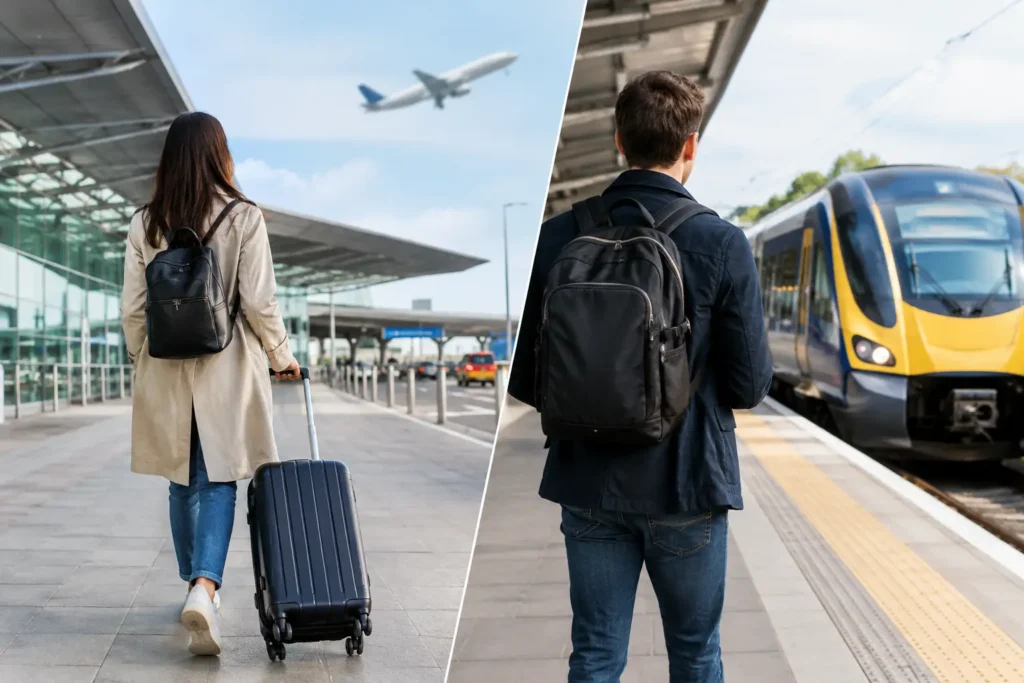
You have landed at Gatwick, collected your suitcase and checked your phone. The next decision can shape the rest of the day: do you follow the signs to the station, or meet a pre-booked driver? When weighing up a Gatwick transfer versus train, the best choice is rarely just about the headline fare. Your arrival time, final address, luggage, travelling party and confidence using London transport all matter.
A train can be an efficient option for a light traveller heading directly to a central London station. A private transfer can be the more comfortable and predictable choice when the journey continues beyond the platform – particularly after a long flight, with children, or when a meeting cannot wait. Here is how to make the right call for your journey.
Gatwick transfer versus train: start with your actual destination
Gatwick has a railway station at the South Terminal, with frequent services towards London. That sounds straightforward, and it can be. But the station is only one part of the journey. Before booking, consider where you need to be after you arrive in London.
If your hotel, office or home is within easy walking distance of Victoria, Blackfriars, London Bridge or St Pancras, rail may be a sensible fit. If you are travelling on to a residential address, a meeting in an unfamiliar area, a cruise terminal, another airport or a location outside central London, the train often involves another stage. That may mean a taxi rank, Underground changes, step-free route planning or carrying bags through a busy station.
A pre-booked Gatwick transfer takes you from the airport to the address you provide. There is no need to work out which exit to use, find a taxi after arriving at a terminal, or decide whether your luggage will fit in a busy carriage. For visitors who do not know London well, that door-to-door certainty can remove a great deal of pressure.
When the train is likely to work well
The train is often a good match for one adult travelling with a small suitcase or rucksack, especially when the destination is close to a central station. It can also suit travellers whose plans are flexible. You do not need to reserve a vehicle, and on many routes you can arrive at the station and take the next available service.
Fast for the right central London routes
Rail can provide a quick link between Gatwick and central London, depending on the service selected and the station you need. It avoids road traffic and can be particularly appealing during busy periods on the roads. For passengers travelling alone, the total rail fare may also be lower than a private car.
That advantage narrows when you add onward transport. Two people paying separate train fares, then taking a taxi from the station to their accommodation, may find that a pre-booked car offers better overall value. The same applies if an inexpensive-looking rail ticket comes with additional charges for connections.
Best when luggage is light
Trains have space for luggage, but that is not the same as having a stress-free luggage journey. At peak times, passengers may be standing, moving through crowded platforms or looking for room near the doors. Large cases, a pushchair, sports equipment and several cabin bags make the experience more demanding.
If you are comfortable managing your belongings and can travel outside the busiest periods, this may not be a concern. If you have just completed an overnight flight, even a short walk with a heavy suitcase can feel longer than expected.
A flexible option, with conditions
Rail services are subject to timetable changes, engineering works and occasional disruption. Checking the live service before you travel is sensible, especially for early departures, weekend journeys and connections to flights. A train may still be the right choice, but it is worth allowing enough time for platform changes and any onward journey from the London terminal.
When a private Gatwick transfer is the better fit
A private transfer is designed around the passenger rather than the network. You book for a set pickup time, share the flight and destination details, and travel in a vehicle selected for your party and luggage. For many passengers, that planning is the value.
Door-to-door travel after a flight
The clearest benefit is simplicity. Instead of arriving at a London station with another journey ahead, you are driven to your hotel, home, office or other agreed destination. This is particularly useful for late-night arrivals, early-morning departures and first visits to the capital.
A licenced driver can help with the practical parts of the journey too: meeting arrangements, loading bags and selecting an appropriate route. With a reputable pre-booked service, you also have a contact point if your flight is delayed or baggage collection takes longer than expected. Clear text or WhatsApp updates can be reassuring when you are trying to find your way through a busy terminal.
More practical for families and groups
A family of four can quickly find that rail is not the easy option it first appears. There may be four fares, several cases, a buggy and tired children to manage. A people carrier or larger vehicle gives everyone a place to sit together, with luggage stored securely rather than carried through stations.
Groups benefit in a similar way. Sharing one vehicle can make the cost per person competitive, while avoiding the risk of people becoming separated during changes. For larger parties, an eight-seat minibus can be a far more sensible arrangement than trying to organise several taxis after a train journey.
A stronger choice for schedule-sensitive travel
Business travellers often choose a transfer because the time between the aircraft door and the final address needs to be dependable. A clean, comfortable car allows you to make a call, review notes or simply arrive composed for the next appointment. Executive vehicles are useful when clients or colleagues are travelling together and first impressions matter.
Road travel is not immune to traffic, so a professional service cannot promise an empty motorway. What it can do is plan the pickup, monitor the expected journey conditions and allow the driver to manage the route. That is very different from arriving at a station and starting your onward planning from scratch.
Compare the full cost, not just the first price
A train ticket is easy to compare because the price is visible per passenger. The true journey cost, however, may include an Underground fare, a bus, a taxi from the final station, and potentially extra time if you need to wait or change routes. For a couple, family or group, add every passenger before deciding that rail is automatically cheaper.
A private transfer should have transparent pricing agreed before travel, so you know what the vehicle is costing rather than watching a meter rise in traffic. Ask whether the quote is appropriate for the number of people and cases travelling. Choosing a saloon car for two passengers with four large suitcases is a false economy; an estate car or people carrier may be the more suitable choice.
It is also fair to put a value on convenience. If a direct car saves an hour of changes and walking after a long-haul arrival, the difference may be worthwhile. If you are a solo passenger with one backpack and an address beside a station, the train may remain the better-value option.
Choose around the passenger, not the route
There is no single answer for every Gatwick journey. A confident commuter travelling alone to Victoria may prefer rail. A family arriving with cases and a child seat requirement will usually appreciate a pre-booked vehicle. A visitor staying in a central hotel may choose either option, while someone travelling to outer London will often find a direct car far easier.
Your arrival time should also influence the decision. During the middle of the day, the choice may be mostly about comfort and budget. Late at night, in poor weather or after a delayed flight, knowing that your transport is arranged in advance becomes more valuable.
If you choose a private service, book early and give accurate flight, terminal, destination, passenger and luggage details. Airlink Transport can then arrange a vehicle that suits the journey, from a saloon car for a straightforward trip to a people carrier or minibus for a larger party. If you choose rail, check the planned service, leave room for the final connection and keep your ticket details accessible before leaving the terminal.
The right journey is the one that lets you arrive calm, on time and ready for what comes next. Plan for the heaviest suitcase, the least confident traveller and the tightest part of your schedule – then your Gatwick arrival is much more likely to feel manageable.